Evidence accumulates showing trans-Atlantic trade/travel by Ancient Egyptians
3,000+ years before Columbus: tobacco, cocaine, and cultural signatures across the Atlantic
The standard narrative claims Europeans first crossed the Atlantic with Columbus in 1492. Evidence suggests Ancient Egyptians did it 3,000 years earlier—possibly more.
The Puzzle
Tobacco is indigenous to the Americas. It arrived in Europe after Columbus, not before.
Cocaine comes from coca plants native to South America. No natural occurrence in Africa, Europe, or Asia.
Yet both substances appear in Egyptian mummies dating to 1000 BC and earlier.
The Chemical Evidence: Drugs in Mummies
1976: Ramses II and Tobacco
Dr. Michelle Lescott (Museum of Natural History, Paris) analysed mummified remains of Pharaoh Ramses the Great using electron microscopy.
Finding: Grains of tobacco clinging to the fibres of his bandages.
Ramses II died circa 1213 BC—over 2,700 years before tobacco supposedly reached the Old World.
Early 1980s: Cannabis, Coca, and Tobacco
Dr. Svetlana Balabanova (Institute of Forensic Medicine, ULM) analysed samples of intestinal tissue from deep inside Ramses II.
Findings:
Traces of cannabis (plausible—known in ancient world)
Traces of coca (impossible via conventional history)
Traces of tobacco (impossible via conventional history)
1992: Seven Mummies, Same Result
Seven ancient Egyptian mummies transferred from Cairo Museum to Munich for analysis. Dr. Balabanova conducted gas chromatography tests on all samples.
Notable case: Henut Taui, priestess of the 21st Dynasty (circa 1000 BC)
Result: Each of the seven individuals tested positive for nicotine and cocaine.
Not contamination. Not a single anomaly. Consistent presence across multiple mummies spanning different periods.
Recent confirmation: Dominique Görlitz (2016) published further research documenting cocaine presence in Egyptian mummies, corroborating Balabanova's findings.
The Cultural Evidence: Architecture and Medicine
Chemical traces aren't the only evidence. Ancient Egyptian cultural signatures appear in Peru and the Canary Islands—locations requiring trans-Atlantic travel.
Shared technologies and practices:
Massive stone manipulation: Precision-cut megalithic blocks, some weighing hundreds of tons, assembled without mortar. Technique characteristic of Ancient Egypt, also found in Peru (Sacsayhuamán, Ollantaytambo).
Anti-seismic construction: Interlocking stones designed to withstand earthquakes. Found in Egyptian structures and Peruvian sites in seismically active regions.
Trepanation: Surgical removal of sections of skull bone. Advanced medical procedure documented in both Ancient Egypt and pre-Columbian Peru with strikingly similar techniques (see Karim Refaey et al., 2019).
Mummification: Preservation of bodies using similar chemical compounds and wrapping techniques. Found in Egypt, Peru, and the Canary Islands.
These aren't superficial similarities. They're complex, specialised technologies requiring detailed knowledge transfer—not independent invention.
Timeline of Evidence
1976: Tobacco discovered in Ramses II bandages (Lescott)
Early 1980s: Cannabis, coca, tobacco in Ramses II tissue (Balabanova)
1992: Nicotine and cocaine in seven mummies (Balabanova)
2016: Cocaine in mummies confirmed (Görlitz)
2019: Comparative analysis of Egyptian and Peruvian trepanation techniques (Refaey et al.)
What This Suggests
If Ancient Egyptians crossed the Atlantic 3,000+ years ago, this adds important dimensions to our understanding:
Ancient maritime capabilities may have been more sophisticated than previously documented. The vessels, navigation techniques, and seafaring knowledge necessary for trans-Atlantic voyages may have existed earlier than current evidence suggests.
Cultural exchange networks were potentially global. Knowledge, technologies, and materials may have circulated across continents through contact networks not yet fully mapped.
The evidence continues to accumulate. Future research may clarify how often such voyages occurred, by what routes, and what other connections remain to be discovered
——————————-
References:
Lescott, M. (1976). Analysis of Ramses II mummy. Museum of Natural History, Paris. [Electron microscopy findings on tobacco in bandages]
Balabanova, S., et al. (1992). First identification of drugs in Egyptian mummies. Naturwissenschaften, 79(8), 358.
Görlitz, D. (2016). [Research on cocaine in Egyptian mummies - full citation needed]
Refaey, K., Quinones, G. C., Clifton, W., Mallela, A. N., Pirris, S. M., & Tubbs, R. S. (2019). The ancient Egyptian and South American cranial trepanation: A historical and anatomical review. Clinical Anatomy, 32(3), 296-303.
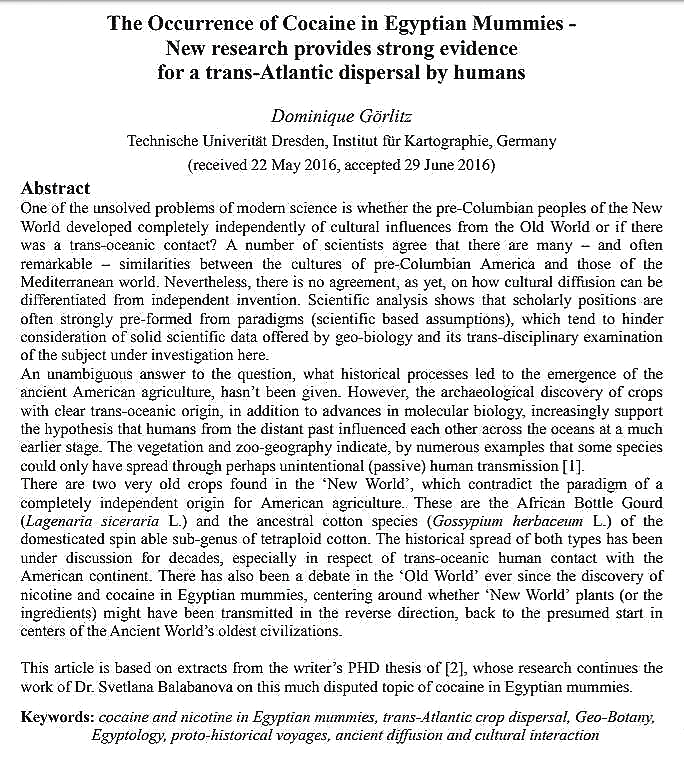
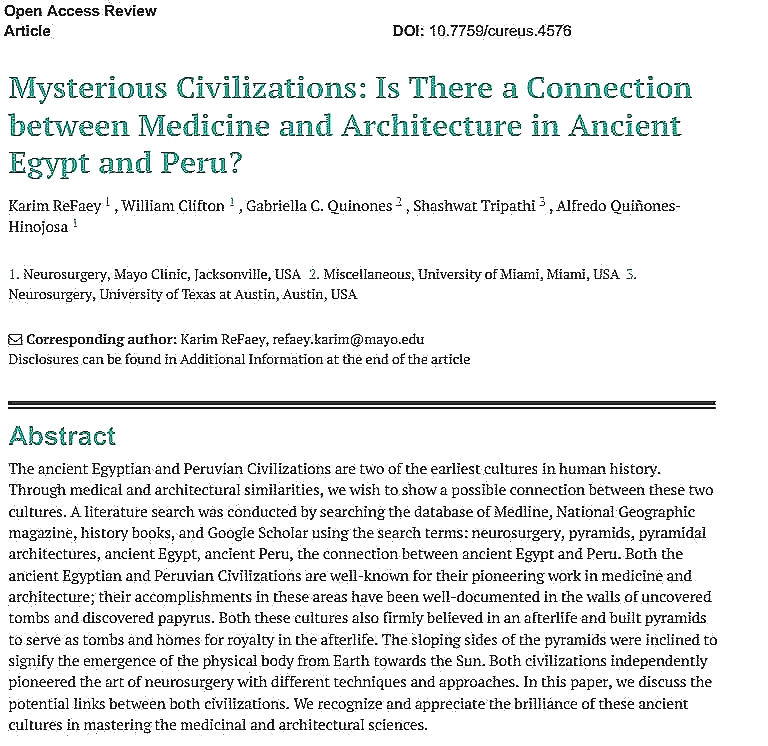

from K. ReFaey et al, 2019.