SARS-CoV-2 RNA Can Be Reverse-Transcribed and Integrated Into Human Genome
Two studies challenge the central dogma assumption
Genomics and epigenomics are young sciences dealing with systems of staggering complexity. Mechanisms operate across multiple spatial and temporal scales, making it computationally impossible to predict global impacts from manipulating isolated components. Even with complete quantitative understanding (equations describing all mechanisms) and adequate computational resources, prediction remains challenging.
The "Vaccine" Terminology Problem
The experimental RNA-based biotechnology developed against SARS-CoV-2 was labelled "vaccine" despite operating through mechanisms that have nothing to do with traditional vaccines. After several years of investigation, this is becoming better understood.
The Findings: DNA Can Be Affected
Two recent studies demonstrate:
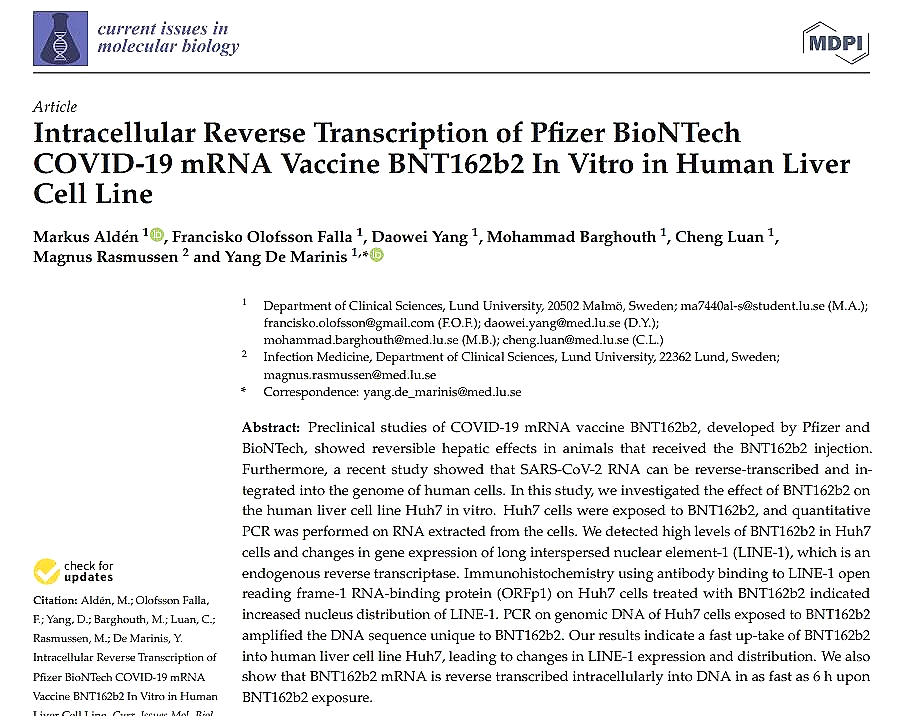
Contrary to widespread dogma, DNA can be affected by the mRNA injections—and this occurs as early as 6 hours post-injection.
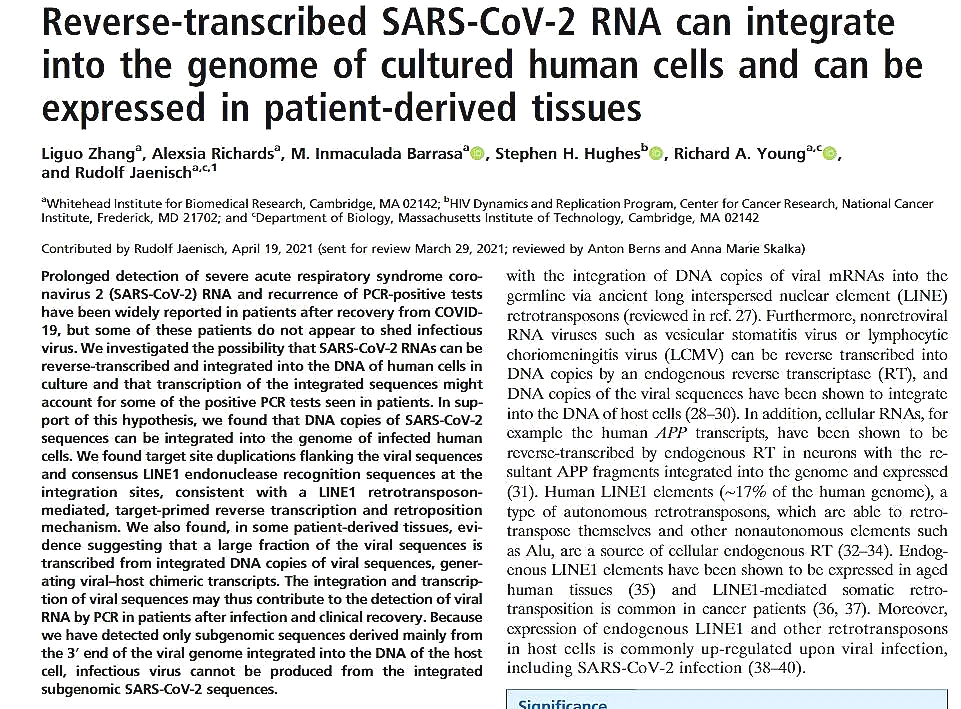
SARS-CoV-2 RNA can be reverse-transcribed and integrated into the genome of human cells.
Study 1: Zhang et al. (2021)
Published in PNAS (Proceedings of the National Academy of Sciences)
Demonstrated reverse transcription of SARS-CoV-2 RNA sequences and integration into human chromosomes.
Open access: https://www.pnas.org/doi/epdf/10.1073/pnas.2105968118
Study 2: Aldén et al. (2022)
Published in Current Issues in Molecular Biology
Confirmed rapid effects: genomic changes detectable within 6 hours of injection.
Open access: https://www.mdpi.com/1467-3045/44/3/73

The Critical Unanswered Question
Duration of genomic modification:
We know integration occurs. We do not know how long it persists.
Is this modification permanent or temporary? Current data cannot answer this question.
What Could Be Done: Transgenerational Studies
Technically feasible research:
We possess the technical capability to investigate genetic and epigenetic effects of these injections across multiple generations. This is not trivial, but it is feasible in animal models (mice).
Precedent: Professor Isabelle Mansuy has conducted transgenerational studies on the effects of emotional trauma in mice, demonstrating epigenetic transmission via germinal cells across generations.
The same experimental framework could be applied to assess whether genomic integration from mRNA injections transmits to offspring and how many generations it persists.
Why this matters: If integration is permanent and heritable, the implications for germline modification are profound. If temporary, the risk profile differs substantially.
We have the tools. The question is whether the studies will be conducted—and by whom.
Context: The Complexity Problem
These findings illustrate why genomic and epigenomic interventions are inherently unpredictable. The system is too complex, too interconnected, too context-dependent for confident prediction of long-term outcomes.
The "central dogma" (DNA → RNA → protein, with no reverse flow) was never absolute—reverse transcriptase enzymes exist naturally (retroviruses, retrotransposons). But the assumption that exogenous mRNA wouldn't integrate into genomic DNA was widespread.
These studies demonstrate that assumption was incorrect.
———————————————————
References (Open Access):
Zhang, L., Richards, A., Barrasa, M. I., Hughes, S. H., Young, R. A., & Jaenisch, R. (2021). Reverse-transcribed SARS-CoV-2 RNA can integrate into the genome of cultured human cells and can be expressed in patient-derived tissues. Proceedings of the National Academy of Sciences, 118(21), e2105968118.
https://www.pnas.org/doi/epdf/10.1073/pnas.2105968118
Aldén, M., Olofsson Falla, F., Yang, D., Barghouth, M., Luan, C., Rasmussen, M., & De Marinis, Y. (2022). Intracellular Reverse Transcription of Pfizer BioNTech COVID-19 mRNA Vaccine BNT162b2 In Vitro in Human Liver Cell Line. Current Issues in Molecular Biology, 44(3), 1115-1126.
https://www.mdpi.com/1467-3045/44/3/73