Can We Control the Brain Remotely and Influence Behaviour?
The fragile reality behind the sci-fi fantasy
The fantasy: In 2015, The Guardian published an article about experimental remote control of mouse brains using heated nanoparticles and light-sensitive proteins. The article itself was measured and accurate - written by science journalist Mo Costandi, it carefully described laboratory research on mice with substantial technical limitations.
But some readers may have interpreted it very differently. Especially after 2020, when COVID-19 mRNA injections became the subject of intense scrutiny. Qualified physicists (including Pablo Campra and colleagues) analysed the contents of these injections and documented the presence of magnetically responsive graphene nanoparticles.
The fantasy that emerged: wireless mind control. Invisible electromagnetic fields directing behaviour. Nanoparticles injected via vaccines, activated remotely. Thoughts implanted from a distance. Memories erased or created at will. Governments or corporations beaming signals into unsuspecting brains. Remote control. No consent required.
This is not what the research shows. Not remotely.
What Actually Exists: Deep Brain Stimulation
Brain stimulation to influence behaviour already exists clinically. Deep brain stimulation (DBS) for Parkinson's disease has been used for decades to compensate for impaired subcortical circuitry resulting from neurodegeneration. It works—but requires inserting electrodes into a very deep brain region (the subthalamic nucleus) via open-skull neurosurgery.
Extremely invasive. Highly targeted. Nothing remote about it.
The quest for less invasive approaches drives substantial neuroscience research programmes. Can we stimulate specific brain circuits without cracking open the skull? This is the actual question these studies address—not "can we control people's minds from a distance?"
The Research: What Are They Actually Trying to Do?
Stated objectives: Fine-grained understanding of subcortical, cortical, and cerebellar circuitry. Most studies make no reference to potential applications in neurology or psychiatry. These are basic science research programmes conducted on animals—mice or rats—at enormous expense.
The fantasy assumes nefarious applications. The reality is scientists trying to map how neural circuits work.
The Methods: How "Remote Control" Actually Works
The principle across these studies is essentially the same: exploit the magnetic or electromagnetic properties of a physical or biophysical element—a nanoparticle, nanomolecule, or protein—that acts as a relay to stimulate ion channels (the basic signalling units) on neuronal membranes at strategic locations within the nervous system.
Two major challenges:
Inserting these elements at the desired location in the brain
Activating them with electromagnetic waves/fields, X-rays, or similar stimulation techniques
Optogenetics: The Dominant Technique
Optogenetics has been developed over the past 10-20 years and exploits a mechanism that already exists in nature—in our retinas. Retinal neurons possess ion-gated channels that open when stimulated by specific electromagnetic wavelengths (visible light). The protein embedded in these channels is called opsin or rhodopsin.

Retinal neurons possess ion-gated channels that open when stimulated by specific electromagnetic wavelengths (visible light). The protein embedded in these channels is called opsin or rhodopsin.
Optogenetics extends this mechanism to neurons within the brain. It requires genetic engineering to express a light-sensitive protein (channelrhodopsin-2 is most commonly used) in a specific brain region. With this modification, researchers can directly control neuronal activity in genetically engineered mice or rats with high spatial and temporal accuracy.
Timeline: Light emission → protein activation → channel activation → channel opening → neuronal signalling
Depending on the site of rhodopsin expression, researchers can inhibit or activate behaviour, trigger emotions, or create memories.
What Has Been Done So Far?
Optogenetics is used primarily in experimental neuroscience to decipher and characterise neuronal circuitry involved in:
Movement and navigation
Learning and memory
Metabolism, hunger, and thirst
Respiration, sleep, and blood pressure
Reward, motivation, and fear
Sensory processing
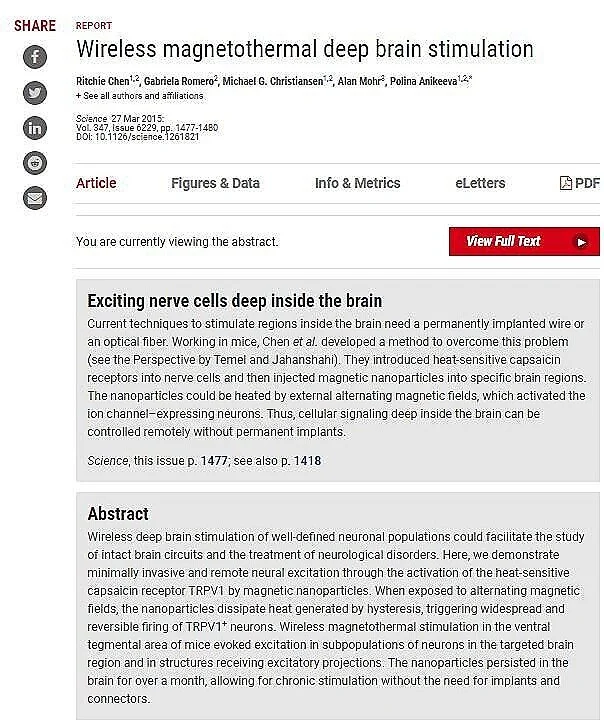
Heated nanoparticles have been used to remotely influence activity in deep brain regions using alternating magnetic fields. The 2015 research reported by The Guardian involved two approaches: (1) gold nanorods that absorb light and convert it to heat, attached to molecules that bind specific neuronal membrane proteins, and (2) iron oxide nanoparticles that heat up in magnetic fields, combined with viral delivery of heat-sensitive TRPV1 channels.
Both methods worked in highly controlled laboratory conditions - tissue slices, genetically modified mice with viral injections, nanoparticles directly injected into specific brain regions. The researchers could activate neurons. They could not inhibit them. The specificity was limited - particles bound to multiple cell types expressing the target proteins, or entered cells randomly around injection sites.
The genetically engineered protein "Magneto" expressed in deep brain structures allowed remote control of motor behaviour in mice—but it did not work in other regions such as the cerebellum.
Reality Check: The Limitations Are Enormous
Limitation 1: Invasiveness
These techniques require:
Genetic engineering to express light-sensitive or magnetic proteins
Injection of heat-sensitive receptors or magnetic nanomaterials
Surgery to implant relay devices or viruses that transport proteins
If you want to target specific brain regions, remote control becomes more invasive, not less. There's nothing wireless about drilling into a skull or injecting viral vectors.
Limitation 2: Targeting Specificity We Don't Have
We cannot (to my knowledge) inject a virus or carrier that selectively targets specific brain regions and triggers expression of magnetoproteins only in those sites. You can't beam a signal at someone's head and activate only the neurons controlling fear, or memory, or decision-making. The required precision doesn't exist.
Limitation 3: Unpredictable Effects
The "Magneto" protein worked in one brain structure but failed in the cerebellum. Why? Because neural circuits are not interchangeable modules. What works in the striatum doesn't necessarily work in the hippocampus or cortex. Each region has different cell types, connectivity patterns, and functional organisation.
This fragility is not a technical hurdle to be overcome with better engineering. It reflects our fundamental lack of understanding about how to predict the effects of stimulating complex, interconnected neural systems. We can trigger activity. We cannot reliably control what that activity will do.
Limitation 4: We Cannot Anticipate or Control Effects
These techniques make possible remote control of local neuronal activity. But anticipating and controlling the effects of such stimulation does not seem possible at this stage. Activating neurons is not the same as producing a specific, predictable behavioural outcome.
The gap between "neurons fire" and "person does what we want" is vast and unbridged.
What Would Actual Remote Mind Control Require?
To achieve the science fiction version—invisible, covert, effective mind control—you would need:
Comprehensive circuit maps we don't have: Detailed understanding of which neural circuits produce which behaviours, thoughts, or emotions. We have fragments of this knowledge. Not the whole picture.
Predictive models we cannot build: The ability to anticipate how stimulating circuit A will cascade through circuits B, C, and D to produce outcome E. Neural systems are nonlinear, context-dependent, and state-dependent. We're nowhere near this level of prediction.
Non-invasive targeting that doesn't exist: A way to selectively activate specific neuron populations without genetic engineering, surgical implants, or viral vectors. We don't have this.
Individual variability we cannot overcome: Neural circuits vary between individuals. A stimulation protocol that works in one person might fail in another. Personalised mind control would require personalised circuit mapping—also not feasible.
None of these conditions are met. Most aren't even close.
The Irony: We're Already Electromagnetically Sensitive
Non-Specific Influence Versus Targeted Control
Can we influence behaviour with electromagnetic waves? Yes. But this requires clarification about what "influence" means.
Non-specific influence exists and is unremarkable: Electromagnetic fields can affect brain states in diffuse, general ways—altering arousal, mood, attention. This is no different from:
Chemical submission - drugs (GHB, benzodiazepines, alcohol) used to incapacitate victims, far more common than widely recognised, particularly in sexual crimes
Gas making people drowsy or dizzy - chemical agents diffusely affecting brain function
Music affecting mood - auditory input changing emotional state
Marketing manipulating choices - visual and linguistic cues exploiting cognitive biases
Perfume influencing attraction - olfactory input affecting limbic responses
Television programming attention - structured visual stimuli capturing cognitive resources
All of these influence behaviour. None constitute precise, targeted control. Chemical submission renders someone incapacitated—it doesn't make them perform specific, complex behaviours on command. Marketing nudges preferences—it doesn't determine exact purchasing decisions in exact individuals at exact times. These methods create conditions that make certain behaviours more or less likely—but they don't determine specific outcomes in specific individuals with precision.
The sci-fi fantasy is about targeted control: "Make this person believe X." "Implant memory Y." "Trigger decision Z at time T." This requires not just influencing brain states generally, but controlling specific neural circuits to produce specific, predictable behavioural outcomes.
The difference is the difference between "make a room of people drowsy" (achievable with CO₂, warm temperature, dim lighting—or chemical agents) and "make person #3 in row 4 remember a false childhood event whilst person #4 performs a complex motor sequence" (not achievable).
Here's the further irony:
Our brains are already equipped with magnetoreceptors. Research demonstrates that humans possess natural electromagnetic sensitivity. All cells of all living organisms are polarised and, as such, are sensitive to electromagnetic waves and fields. See a paper here.
No injection needed. No genetic engineering required. No surgical implantation necessary.
We are naturally responsive to electromagnetic environments. Yet we don't see targeted mind control via mobile phone towers, power lines, or Wi-Fi routers. Why? Because sensitivity to electromagnetic fields produces non-specific effects—perhaps altering sleep patterns, mood, or arousal—not controllable, predictable, targeted behavioural outcomes.
The presence of magnetoreceptors tells us something interesting about biology. It does not enable remote puppeteering of specific behaviours in specific individuals.
Conclusion: Influence Is Not Control
Brain stimulation technologies exist. They're advancing. Optogenetics is scientifically valuable for understanding neural circuits. Deep brain stimulation helps Parkinson's patients. Research into less invasive approaches is worthwhile.
Can we influence brain states and behaviour with electromagnetic fields? Yes—in the same diffuse, non-specific way that gas can make you drowsy, music can affect mood, or marketing can shape preferences. These are real effects. They're just not targeted control.
The gulf between current capabilities and the sci-fi nightmare of remote, targeted mind control is enormous. The technologies that approach precision—optogenetics, deep brain stimulation—are fragile, invasive, unpredictable, and require targeting precision we don't possess. They work in highly controlled laboratory conditions with genetically modified animals and implanted hardware.
The fantasy persists because it's emotionally compelling. The reality—laborious, expensive, incremental progress toward understanding how brains work—is far less dramatic.
People worry about technologies that don't exist whilst living with non-specific influences (advertising, social media, electromagnetic environments) that demonstrably shape behaviour. This isn't rational threat assessment. It's science fiction mistaken for imminent reality.
Remote, targeted mind control remains, for now and the foreseeable future, in the realm of fiction. We can influence brain states diffusely. We cannot control specific behaviours precisely. The technologies are too fragile. The knowledge is too incomplete. And the brain is far more complex than the fantasies acknowledge.